
The Ultimate Apprenticeship Learner File Audit Checklist for 2026
Updated: Aug 13
An administrative oversight in a single record should never be the reason your organisation faces a significant funding clawback. It's a reality that many providers find the volume of evidence required for a robust apprenticeship learner file audit to be overwhelming, particularly since the transition of oversight to the ESFA / DWP has introduced specific nuances to the 2026 funding rules. You're likely all too familiar with the pressure of ensuring every training plan and activity log aligns perfectly with the latest requirements of the Growth & Skills Levy.
This guide is designed to remove that burden and help you master the complexities of ESFA / DWP compliance. We'll provide the clarity you need to conduct internal reviews with total confidence, ensuring your government apprenticeship funding remains secure long before an official auditor arrives. We will explore the essential documentation checklist for 2026, outline a repeatable process for file organisation, and highlight the critical evidence needed to prove active learning throughout the programme.
Table of Contents
The Strategic Importance of the Apprenticeship Learner File Audit
In the context of the UK’s Apprenticeship system, the learner file is far more than a collection of paperwork. It's the "single source of truth" for every pound of government apprenticeship funding claimed. Each document, from the initial assessment to the final achievement certificate, serves as the primary evidence that training has occurred according to the funding rules. When you conduct a regular apprenticeship learner file audit, you aren't just checking boxes; you're protecting your organisation’s reputation amongst employers and stakeholders. A robust file demonstrates that you're a dependable partner capable of delivering high-quality training whilst maintaining meticulous records.
There's also a direct link between file compliance and Ofsted’s "Leadership and Management" grade. Inspectors look for evidence that leaders have a firm grip on the quality and validity of their provision. By implementing a proactive audit cycle, you move away from reactive "firefighting" during inspection windows and toward a culture of continuous compliance. This steady approach instils confidence across your entire team. It ensures that your data is always ready for scrutiny.
Beyond Compliance: Auditing as a Quality Tool
Auditing provides a unique window into the actual learner experience. By reviewing files, you can identify subtle gaps in the curriculum or areas where learner support might be lacking. For example, if multiple files show a lack of progress in specific modules, it may signal a need for curriculum redesign rather than a simple administrative error. Regular reviews help you refine the "Learner Journey," ensuring that every apprentice receives the support they're entitled to. Additionally, common errors found during an apprenticeship learner file audit are invaluable for identifying specific staff training needs. This allows you to address knowledge gaps before they impact your data accuracy or learner outcomes.
The Financial Risk of Inadequate Evidence
The financial implications of administrative errors are significant. If an audit by the ESFA / DWP uncovers insufficient evidence for active learning, the mechanism for funding clawbacks is swift and often severe. Administrative rework after a failed audit is far more costly than the investment required to get it right the first time.
Funding assurance is a proactive risk-mitigation strategy that ensures all claims are backed by verifiable evidence, effectively acting as a protective shield for your organisation’s revenue. By securing your evidence today, you're safeguarding the future growth of your provision under the Growth & Skills Levy.
Anatomy of a Compliant File: Evidence Requirements for 2026
At its core, an apprenticeship learner file serves as the definitive record of a learner's journey, encompassing three critical pillars: eligibility, activity, and achievement. It's the repository that justifies every payment received from the Growth & Skills Levy.
For 2026, the standard for what constitutes a "complete" file has evolved, moving decisively toward a digital-first approach. This means that electronic signatures must be verifiable and e-portfolio entries must be time-stamped to meet the latest funding rules.
One of the most common pitfalls found during an apprenticeship learner file audit is the use of retrospective evidence. Funding requirements are clear; evidence of learning must be contemporaneous. You cannot reconstruct activity logs months after the training took place without risking significant clawbacks.
Similarly, the Training Plan is no longer a "set and forget" document signed at enrolment. It must remain a live, working record that reflects changes in the learner's circumstances or progress throughout the programme.
Core Compliance Documents Every File Needs
Every file must contain a set of non-negotiable documents that form the basis of the funding claim.
These include:
Apprenticeship Agreement and Training Plan: These documents form the contractual foundation, clearly outlining the roles of the provider, employer, and apprentice.
Initial Assessment results: These are vital for proving that the apprentice actually needs new learning. You must document prior learning recognition to ensure funding is only claimed for new knowledge, skills, and behaviours.
Eligibility evidence: This includes robust checks on residency, right to work, and prior attainment to confirm the learner is eligible for government apprenticeship funding.
Digital Evidence and E-Portfolio Management
Digital platforms have streamlined record-keeping, but they bring their own set of audit risks. Every piece of evidence in an e-portfolio must be clearly linked to the training plan and time-stamped to prove when the activity occurred.
In 2026, there's a heightened focus on evidencing "active learning" rather than simply counting hours. Your off-the-job training (OTJT) logs must describe the specific learning that took place and how it relates to the apprenticeship standard. This ensures that the evidence is qualitative, not just quantitative.
Maintaining a clear audit trail becomes particularly challenging when transitioning between different digital systems or updating internal software. If you're concerned about how your digital records would stand up to scrutiny, a professional Funding Assurance Review can identify potential gaps in your evidence chain. This proactive "stress test" ensures your files are robust enough to pass any official inspection from the ESFA / DWP.
Identifying and Mitigating Common Audit Risks
Identifying vulnerabilities before an official apprenticeship learner file audit takes place is the most effective way to protect your provision. One of the most prevalent challenges providers face is the "OTJT Gap." This occurs when planned off-the-job training hours don't align with the actual hours recorded in the learner's log. It often stems from changes in workplace responsibilities or unexpected absences that aren't accounted for in real-time. To fix this, you must implement a robust process for monthly reconciliation. Ensure the training plan reflects reality rather than just the initial ambition set at enrolment.
In 2026, proving "active learning" has become a non-negotiable requirement for securing government apprenticeship funding. You must demonstrate that the apprentice has engaged in meaningful learning activity during every single calendar month of the programme. A single missing month without a recorded break in learning can trigger a query during a funding assurance review. This requires a methodical approach to checking activity logs against the ILR data to ensure every claim is backed by contemporaneous evidence. If a learner isn't active, the funding must be paused immediately to avoid administrative errors.
The Prior Learning Pitfall
The ESFA / DWP has placed increased focus on the "Recognition of Prior Learning" (RPL). Simply waiving modules or training hours without robust evidence is a significant risk that often leads to funding clawbacks. You must document exactly how prior experience or qualifications have led to a specific reduction in both the duration and the price of the apprenticeship. Mapping prior skills to the apprenticeship standard must be precise. Vague descriptions of "previous experience" won't suffice under 2026 funding rules; you need diagnostic results or work-based evidence to justify the reduction.
Price Transparency and Employer Agreement
Transparency in price negotiation is essential for compliance and maintaining your organisation's reputation. You must clearly break down the Total Negotiated Price into training (TNP1) and assessment (TNP2) costs. It's vital to prove that the employer was actively involved in this negotiation and agreed to the final figures.
Your apprenticeship learner file audit should verify that the breakdown of eligible versus ineligible costs is documented and that the signed paperwork matches your ILR data exactly. Discrepancies here are frequently flagged as high-risk errors that suggest a lack of oversight. By aligning your data with your physical evidence, you create a seamless audit trail that supports the integrity of your Growth & Skills Levy claims.
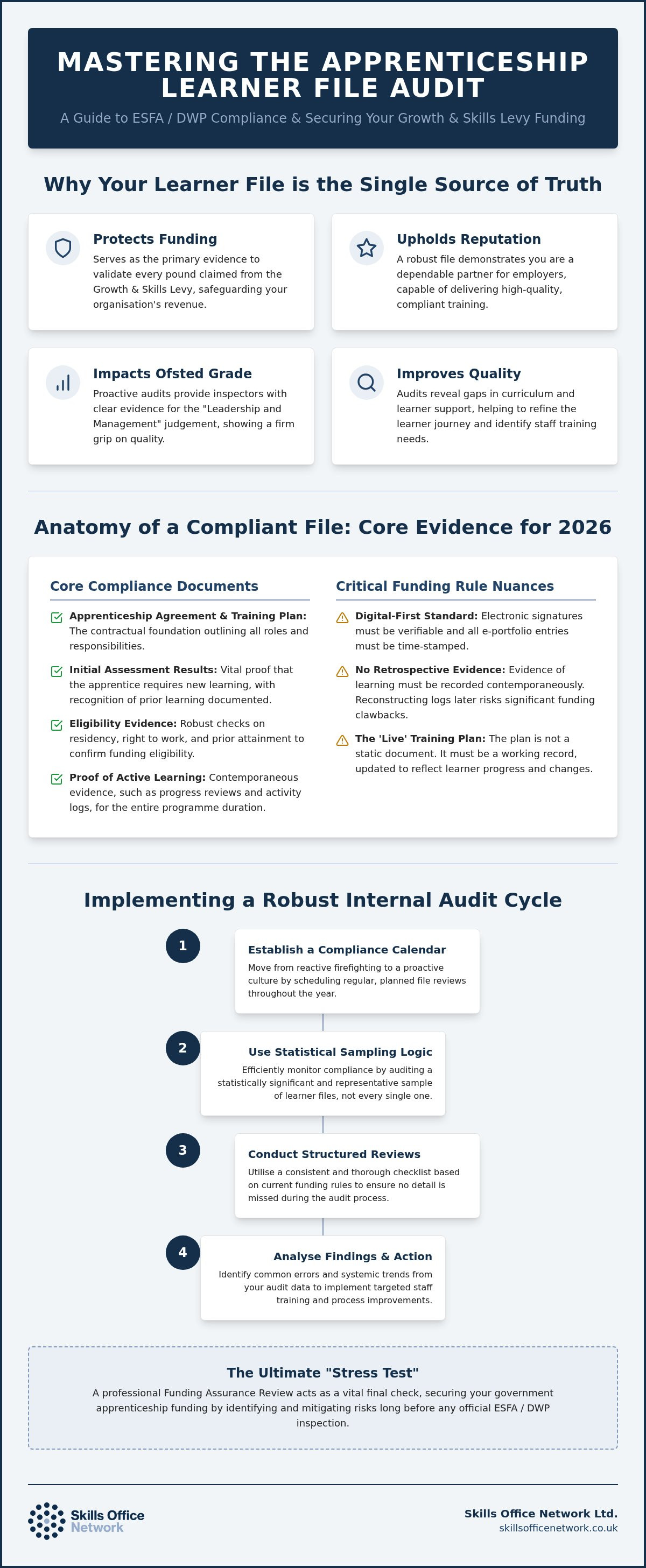
Implementing a Robust Internal Audit Cycle
Establishing a structured rhythm for your compliance checks is the most effective way to protect your Growth & Skills Levy funding. A sporadic apprenticeship learner file audit won't catch the subtle errors that lead to significant clawbacks. Instead, you should implement a five-step cycle that mirrors the actual learner journey. It's about moving from a reactive stance to a proactive culture of quality.
Your internal cycle should follow these logical steps:
Step 1: Establish a "Compliance Calendar" that aligns with your monthly ILR submission dates to ensure data and physical evidence are always synchronised.
Step 2: Select a statistically significant sample of files, using risk-based logic to focus on complex or high-value starts.
Step 3: Conduct a "Deep Dive" review using a standardised audit tool to ensure every file is measured against the same 2026 funding rules.
Step 4: Report your findings clearly and implement "Remedial Action Plans" to correct any administrative errors immediately.
Step 5: Close the loop by updating your internal processes and training staff to prevent the same errors from recurring in future cohorts.
Sampling Strategies: PDSAT and FRM Reports
Effective auditing relies on intelligent sampling rather than just checking a random percentage of files. You should use the Provider Data Self-Assessment Tool (PDSAT) to identify high-risk files that may contain anomalies, such as overlapping dates or unusual OTJT patterns. Similarly, Funding Monitoring Reports (FRM) act as a vital early warning system. These reports help you spot potential issues before they result in a formal query from the ESFA / DWP. By targeting your audit where the risk is highest, you make the best use of your administrative resources.
The Internal Audit Workflow
Independence is a critical component of a successful apprenticeship learner file audit. Ideally, the individual conducting the review shouldn't be part of the direct delivery team for the files being checked. This objectivity ensures that errors aren't overlooked due to familiarity. Many successful providers also use "Peer Reviews" as a dual-purpose tool for quality assurance and staff development. This collaborative approach helps disseminate best practices across the organisation. Documenting this entire workflow is essential for proving robust "Governance" to Ofsted, showing that your leaders have active oversight of government apprenticeship funding.
If you want to ensure your internal cycle is truly robust, you can book a professional Funding Assurance Review to stress-test your processes before an official inspection.
Positioning your organisation for growth requires a fundamental shift in how you view regulatory oversight.
An independent "Mock Audit" is the most effective way to prepare for the ESFA / DWP, providing a level of rigour that internal reviews often lack. At Skills Office Network, we act as a strategic partner, offering a steady hand to help you navigate the complexities of the 2026 funding rules. For many providers, especially those managing a high volume of learners, outsourced ILR and data support is the key to reducing administrative overheads. By implementing a professional apprenticeship learner file audit, you transform compliance from a defensive chore into a competitive advantage that proves your operational excellence.
Our Funding Assurance Review Process
Our approach is designed to be a comprehensive "stress test" for your organisation. We perform a detailed analysis of your records, conducting an apprenticeship learner file audit that leaves no stone unturned.
By using the latest 2026 standards, we identify financial risks and present them in a clear, actionable report that quantifies potential clawbacks in pounds and pence. This clarity empowers you to make informed decisions about your provision. We don't just point out problems; we provide the expert guidance needed to correct historical errors and "clean" your ILR data. This ensures your digital records and physical evidence are in perfect harmony before any official inspection.
Partnering for Long-Term Success
Securing your government apprenticeship funding is a continuous process that requires expert oversight at every stage. Our consultancy services provide ongoing support for APAR, Governance, and Ofsted preparation, ensuring you remain compliant as the landscape evolves. We work with your delivery staff to build a "Compliance First" culture, where high standards of evidence collection are woven into the fabric of the apprenticeship programme. This proactive stance protects your income from the Growth & Skills Levy and builds lasting trust with employers. To ensure your files are robust and your funding is secure, contact our team to schedule your 2026 Funding Assurance Review.
Securing Your Future Under the Growth & Skills Levy
Navigating the complexities of the 2026 funding rules requires more than just administrative diligence; it demands a strategic commitment to quality. Throughout this guide, we've explored how maintaining the learner file as a "single source of truth" protects your organisation from the risks of the "OTJT Gap" and ensures every claim is backed by contemporaneous evidence.
By implementing a robust internal apprenticeship learner file audit cycle, you move from reactive firefighting to a position of total confidence in your data accuracy. Compliance shouldn't be a burden.
If you want to ensure your provision is inspection-ready, you can Book a Professional Funding Assurance Review with Skills Office Network Ltd.. Our team provides expert ILR data management support and has a proven track record in Ofsted and ESFA / DWP preparation, offering comprehensive 360-degree provider support.
Skills Office Network Ltd. acts as your strategic partner, removing the administrative burden so you can focus on delivering high-quality apprenticeships. With the right systems in place, you can grow your provision with the peace of mind that your government apprenticeship funding is secure.
Frequently Asked Questions
What is the most common reason for failing an apprenticeship learner file audit?
The most common reason for failing an audit is a lack of contemporaneous evidence for active learning. If an apprentice doesn't have recorded activity in every calendar month, the funding claim becomes ineligible. Providers often struggle with gaps in training logs that don't match the expectations of the Growth & Skills Levy. Ensuring that every entry is time-stamped and clearly linked to the apprenticeship standard is essential for maintaining compliance.
How often should we conduct internal learner file audits?
You should conduct an internal apprenticeship learner file audit at least once a quarter, though monthly reviews are preferred to align with ILR submission dates. Regular sampling allows you to identify and rectify administrative errors before they escalate into systemic issues. By maintaining a steady rhythm of oversight, you ensure that your evidence remains robust and your funding claims are always backed by verifiable data.
Can we use electronic signatures for all apprenticeship compliance documents in 2026?
Yes, electronic signatures are fully acceptable for all compliance documents in 2026, provided they meet the standards for security and traceability. The signature must be verifiable and time-stamped to prove the document was signed by the correct parties on the stated date. Using a reputable e-signature platform ensures that your audit trail remains intact and meets the stringent requirements of the current funding rules.
What happens if we find a funding error during an internal audit?
If you discover a funding error, you must take immediate remedial action by correcting the ILR data and documenting the fix. This might involve pausing funding for a specific period or issuing a voluntary repayment if a claim was made in error. Transparency is key; keeping a clear record of how you identified and resolved the issue demonstrates strong governance and a commitment to integrity.
How long must we keep apprenticeship learner files after the programme ends?
You must typically retain apprenticeship learner files for at least six years after the end of the financial year in which the programme was completed. However, specific contracts or legacy funding requirements may demand longer retention periods, sometimes up to ten years. It's vital to maintain these records in a secure, accessible format, as they remain the primary evidence for any retrospective funding assurance reviews.
Does Ofsted look at the same things as the ESFA / DWP during an audit?
Whilst their focuses differ, Ofsted and the ESFA / DWP often scrutinise the same evidence. The ESFA / DWP focuses on financial compliance and eligibility, whereas Ofsted examines the quality of education and leadership. However, Ofsted uses the learner file to verify that the curriculum is being delivered as planned. A well-organised file serves both purposes, proving that you're delivering high-quality training that meets all funding requirements.
Is a "Training Plan" the same as an "Apprenticeship Agreement" for audit purposes?
No, the Training Plan and the Apprenticeship Agreement are distinct documents, and both are essential for a compliant file. The agreement is a legal contract regarding employment, whilst the Training Plan outlines the specific learning journey, including OTJT hours and milestones. For an apprenticeship learner file audit to be successful, both must be signed, dated, and kept up to date to reflect the current reality of the training.
How do we prove Off-the-Job Training (OTJT) if a learner works remotely?
Proving OTJT for remote learners requires robust digital evidence, such as time-stamped entries in an e-portfolio or records of attendance at virtual training sessions. You must ensure that the work produced during remote hours is clearly documented and mapped to the training plan. Narrative logs that describe the specific knowledge or skills gained are much more persuasive to auditors than simple spreadsheets showing only hours.


