
The Essential Guide to Apprenticeship Curriculum Review in 2026
Updated: Aug 17
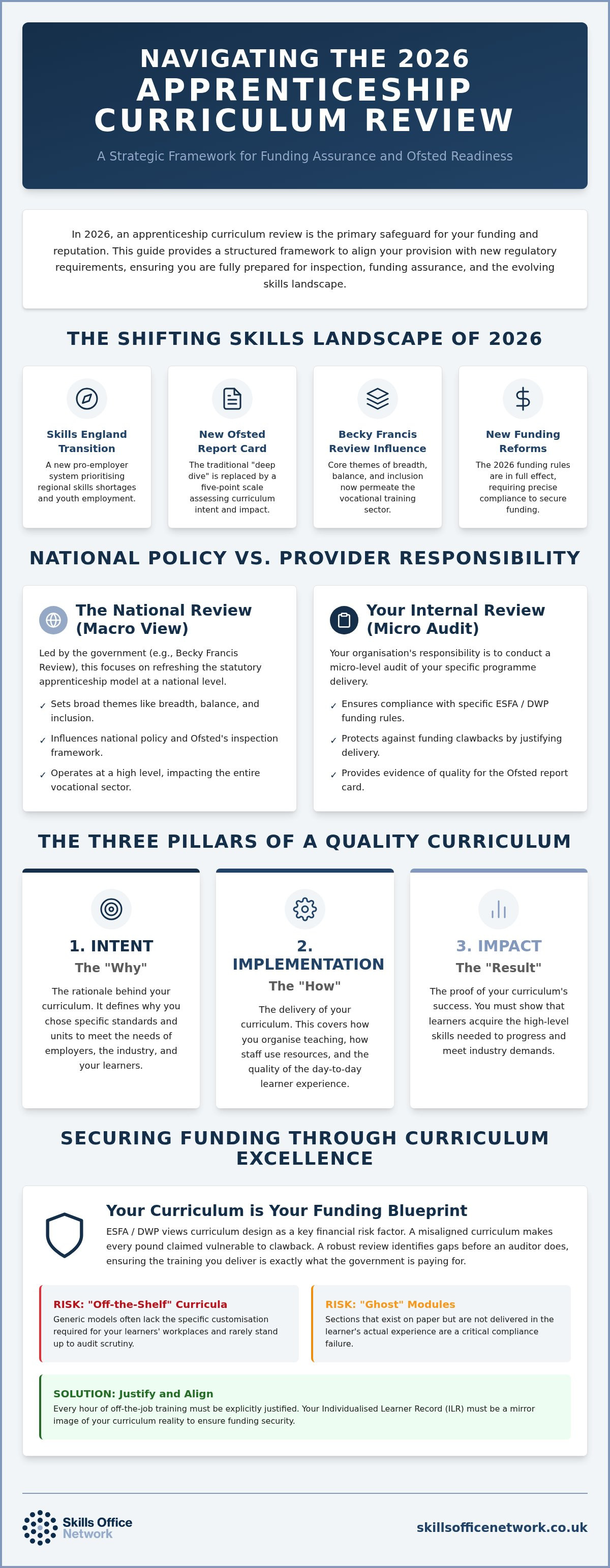
In 2026, an apprenticeship curriculum review is no longer a simple administrative task; it's the primary safeguard for your funding and your reputation. You've likely felt the pressure of the shifting landscape, from the transition to Skills England to the new Ofsted report card system that replaces the traditional "deep dive" approach. It's natural to feel concerned about whether your curriculum intent still aligns with the latest 2026 standards or if the national Becky Francis review has changed your internal obligations. We understand that the distinction between these external policy shifts and your own quality processes can feel blurred, especially with the 2026 funding reforms now in full effect.
This guide provides the clarity you need to align your provision with the new regulatory requirements, ensuring you're fully prepared for both inspection and funding assurance. We'll explore a structured framework for auditing your curriculum, documenting impact under the new five-point report card scale, and securing your 2026 funding through precise compliance. By the end of this article, you'll have a manageable path forward to transform your curriculum into a robust asset for your learners and your business.
Table of Contents
What is an Apprenticeship Curriculum Review in 2026?
An apprenticeship curriculum review is a systematic evaluation of how your organisation delivers training against established national standards. It's a rigorous process that examines whether your teaching models actually meet the needs of modern industry. In 2026, this review has become more critical than ever. With the transition from IfATE to Skills England now complete, the focus has shifted toward a pro-employer system that prioritises regional skills shortages and youth employment. You must ensure your provision isn't just a legacy model but a responsive, high-quality programme.
Many providers confuse the national Becky Francis review with their own internal obligations. While the government focuses on refreshing the statutory Apprenticeship model at a macro level, your internal review is a micro-level audit. It ensures your specific delivery remains compliant with the latest funding rules, such as the 12-month levy expiry and the new 75% co-investment rate for large employers. A robust review protects you from the risk of funding clawbacks and ensures your documentation is ready for the new Ofsted report card system. It's about moving from administrative compliance to strategic excellence.
Distinguishing Between Intent, Implementation, and Impact
To conduct a successful apprenticeship curriculum review, you must understand the three pillars of quality. Intent defines your ambition. It's the rationale behind why you chose specific units or the new Level 2 Administration Assistant standard for 16-24 year-olds. Implementation focuses on the delivery. This includes how you organise teaching sessions and whether your staff are effectively using the new apprenticeship units introduced in April 2026. Finally, Impact measures the result. You must prove that learners are acquiring the high-level skills needed for industrial strategy priority sectors, where demand is expected to rise by nearly a quarter over the next decade.
The Role of the Becky Francis Review in Apprenticeships
The 2025-2026 transition period has seen a significant shift in national education policy. While the Becky Francis review originally targeted the 5-19 curriculum, its core themes of breadth and balance have permeated the vocational sector. From September 2026, Ofsted inspectors will use a five-point report card scale to assess how well you support learners with barriers to their learning or wellbeing. Your internal review must now account for this focus on inclusion. It's no longer enough to teach technical skills; you must demonstrate a proactive approach to reducing learning barriers to meet the expected standard for inclusion.
The Strategic Link Between Curriculum and Funding Assurance
The ESFA / DWP views curriculum design not merely as a pedagogical choice, but as a significant financial risk factor. When your curriculum lacks clear alignment with the apprenticeship standard, every pound claimed becomes vulnerable to clawback. A robust apprenticeship curriculum review identifies these gaps before an auditor does. It ensures that the training you deliver is exactly what the government is paying for, removing the ambiguity that often leads to compliance failures. Your curriculum is essentially the blueprint for your funding claims.
Relying on "off-the-shelf" curricula is increasingly dangerous in this strict environment. These generic models often fail to account for the specific skills needed in your learners' workplaces. They rarely stand up to the scrutiny of an apprenticeship funding assurance audit because they lack the necessary customisation. By tailoring your delivery, you demonstrate that your provision is built on actual industry demand. This direct link between teaching and the standard is what secures your financial position.
Mapping Curriculum to the Training Plan
A thorough apprenticeship curriculum review ensures that every hour of off-the-job training is explicitly justified. Auditors look for "ghost" modules, which are sections of a programme that exist on paper but aren't realised in the learner's actual experience. Your Individualised Learner Record (ILR) must be a mirror image of your curriculum reality. If your data indicates a learner is studying the new apprenticeship units introduced in April 2026, your curriculum mapping must prove exactly how that teaching occurred. This level of detail removes the administrative friction that often complicates funding reviews.
Compliance with 2026 Funding Rules
Significant changes to the levy system in August 2026 have tightened the financial requirements for all providers. Large employers no longer receive the 10% monthly top-up, and their co-investment rate has been reduced from 95% to 75%. These shifts mean your curriculum must be more efficient than ever to remain viable. Documenting curriculum changes is now a vital part of your governance. You must show how you've adapted to these new rules, perhaps by integrating the Level 2 Administration Assistant standard for younger learners.
For those seeking a broader perspective on vocational frameworks, resources like Apprenticeship.gov offer insights into global standards, though your primary focus must remain on the UK's specific 2026 mandates.
Securing your financial health requires a proactive stance toward quality. If you're concerned about how your teaching plans might affect your next audit, a professional funding assurance review can provide the clarity and confidence you need to move forward.
Although Ofsted has moved toward a five-point report card system in 2026, the rigorous scrutiny of your teaching plans remains a central focus. Inspectors now look for evidence that your apprenticeship curriculum review is a dynamic process, specifically addressing the "skills for the future" required by industrial strategy priority sectors. You must demonstrate how your delivery incorporates digital literacy and high-level technical competencies. It isn't just about following a standard; it's about proving your curriculum is a direct response to the 16.2% youth unemployment rate by creating genuine, high-value pathways to work.
Demonstrating local and national relevance is a cornerstone of the 2026 framework. Skills England now prioritises regional needs, meaning your review must show active engagement with local employers. You shouldn't just guess what businesses need. Instead, use data-driven insights to align your training with actual job market trends. This evidence-based approach shows that your quality improvements are rooted in reality rather than theory.
For those looking for a broader perspective on how these assessments are structured, Apprenticeship Program Reviews offer a useful comparison of how curriculum and delivery systems are evaluated through formalised oversight.
Evidencing the Quality of Education
Moving beyond simple completion rates is essential for an "Expected" or "Exceeding" report card grade. You must demonstrate genuine skill mastery. Your Self-Assessment Report (SAR) should act as a transparent narrative of your curriculum's evolution. It must highlight how employer feedback has directly shaped your teaching modules. If an employer identifies a gap in a learner's technical ability, your SAR should document the specific curriculum shift you made to address it. This level of transparency instils confidence in inspectors and demonstrates a culture of continuous improvement.
Preparing Staff for Curriculum Interviews
Inspectors will interview trainers and assessors to verify the "why" behind your programme. Consistency is the goal. If your stated intent is to support learners with barriers to wellbeing, your staff must explain how their daily implementation reflects this. Implementation must match the intent described in your documentation.
Mock inspections and independent Ofsted readiness reviews are invaluable here. They provide a safe environment for staff to practice articulating the curriculum's impact, ensuring they feel confident rather than interrogated during the actual visit. This preparation ensures that your team acts as a unified voice for your organisation's quality standards.
How to Conduct a Provider-Level Curriculum Review
An effective apprenticeship curriculum review requires a methodical approach that moves from high-level strategy to granular delivery details. It's no longer sufficient to update your slides once a year. You must prove that your programme remains responsive to a shifting economy. By following a structured five-step framework, you can ensure your provision satisfies the dual demands of Ofsted quality and ESFA / DWP funding compliance. This process transforms your curriculum from a static document into a live tool for excellence.
Step 1: Stakeholder Consultation and Labour Market Analysis
Start by gathering meaningful feedback from both levy-paying and non-levy employers. With the 2026 removal of employer contributions for SMEs hiring 16-24 year-olds, your non-levy partners may have different curriculum needs than in previous years. Analyse current Local Skills Improvement Plan (LSIP) data to ensure your programmes address specific regional shortages. This step identifies the skills gaps that your curriculum must fill to remain relevant in a pro-employer system. You're looking for evidence that your training solves real-world recruitment challenges.
Step 2: Component Mapping and Content Refresh
Review every module against the latest Apprenticeship Standard KSBs. You must account for the August 2026 assessment reforms, which remove "behaviours" from formal assessment in favour of employer verification. Your content refresh should also integrate the new apprenticeship units introduced in April 2026, particularly in digital and green sectors. For each programme, write a single, punchy sentence defining your curriculum intent. This clarity helps delivery staff and inspectors understand exactly what the learner is expected to achieve and why.
Step 3: Implementation Audit and Resource Check
Assess whether your delivery staff possess the Continuing Professional Development (CPD) required to teach updated curriculum elements. If you've integrated new AI or engineering units, your trainers must be experts in those fields. Review your Virtual Learning Environment (VLE) content to ensure it's accurate and engaging. The sequence of learning is vital here. You must demonstrate that the curriculum builds logically, ensuring learners master foundational concepts before moving to complex tasks. This logical progression is a hallmark of high-quality vocational pedagogy.
The final stages of your review should bridge the gap between the "Practical Period" and End-Point Assessment (EPA). You must ensure that EPA preparation isn't a bolt-on activity but a natural conclusion to the learning journey. Once complete, use your findings to update your Quality Improvement Plan (QIP), turning identified weaknesses into actionable targets. If you need support with this structured approach, our team provides expert Ofsted inspection support to help you refine your curriculum and secure your organisation's future.
How Skills Office Network Ltd. Supports Your Curriculum Excellence
Bridging the gap between ambitious curriculum design and rigorous regulatory compliance is a challenge that requires both technical precision and strategic foresight. At Skills Office Network Ltd., we act as a steady hand for providers navigating the complexities of the 2026 skills landscape. Our consultancy services are built on the understanding that a high-quality apprenticeship curriculum review is the foundation of both educational impact and financial security. We don't just identify gaps; we provide the manageable solutions required to close them, ensuring your provision remains a beacon of quality in a competitive market.
Our expertise extends beyond theoretical advice to practical, hands-on support. We specialise in aligning your internal processes with the latest government standards, ensuring that your intent, implementation, and impact are clearly documented and evidenced. By providing an independent perspective, we help you see your provision through the eyes of an inspector or an auditor, allowing you to address potential risks long before they escalate into administrative burdens.
Our Approach to Curriculum Design
We provide tailored support for ITPs, employer providers, and local authorities, recognising that each organisation faces unique hurdles. Our goal is to reduce administrative friction whilst enhancing the educational quality of your programmes. As your wise guide, Skills Office Network Ltd. translates complex technical requirements into actionable quality frameworks. Whether you're integrating the new apprenticeship units introduced in April 2026 or adapting to the removal of behaviours from formal assessment, we ensure your curriculum modelling is robust and future-proof. This partnership approach allows your team to focus on what they do best: delivering exceptional training to your learners.
Securing Your Organisation's Future
Protecting your funding requires more than just clean data; it requires an Individualised Learner Record (ILR) that is backed by a robust curriculum. Our Funding Assurance Reviews specifically examine the link between your training plans and your financial claims, safeguarding you against the risk of clawbacks. Simultaneously, we prepare your team for the 2026 Ofsted report card system with confidence. Through independent readiness reviews and support with Self-Assessment Report (SAR) and Quality Improvement Plan (QIP) development, Skills Office Network Ltd. helps you showcase your curriculum's strengths. Securing your future starts with a proactive approach to quality. You can arrange a comprehensive curriculum review with our expert team today to ensure your organisation is fully prepared for the challenges ahead.
Securing Your Provision in the 2026 Skills Landscape
A robust apprenticeship curriculum review is no longer just a quality exercise; it's the fundamental cornerstone of success under the new Skills England oversight. We've explored how aligning your curriculum intent with the 2026 report card system ensures Ofsted readiness whilst protecting your funding from clawbacks. By implementing a structured audit framework that engages employers and addresses regional skills shortages, you can turn administrative complexity into a strategic advantage for your learners and your business.
Navigating these regulatory shifts requires a partner who understands the nuances of the UK training landscape. As specialists in Ofsted inspection support and ILR compliance with national coverage, Skills Office Network Ltd. is dedicated to helping you achieve excellence. We provide the steady hand and deep institutional knowledge needed to streamline your operations and secure your future. Secure your funding and Ofsted rating with a professional curriculum review from Skills Office Network Ltd. Taking proactive steps today will position your organisation as a leader in the evolving world of vocational training.
Frequently Asked Questions
Is the national curriculum review applicable to all apprenticeship providers?
The national review led by Becky Francis primarily focuses on the statutory 5-19 curriculum. However, its core themes of breadth and inclusion influence vocational standards across the board. Whilst the national review isn't a direct mandate for individual providers, conducting a provider-level apprenticeship curriculum review remains a regulatory requirement. This ensures your specific delivery models align with Skills England's 2026 priorities and meet the evolving needs of your employer partners.
How often should a training provider conduct a curriculum review?
You should conduct a comprehensive review at least once per year as part of your Quality Improvement Plan cycle. However, the 2026 landscape requires more agility than a single annual check. If a standard is updated, such as the August 2026 assessment reforms, or if local skills needs shift significantly, an interim review is essential. Regular audits ensure your curriculum intent remains relevant and your funding claims stay secure against evolving rules.
What is the difference between a learner progress review and a curriculum review?
A learner progress review focuses on an individual's journey toward their KSBs, occurring typically every 12 weeks to track personal milestones. In contrast, an apprenticeship curriculum review evaluates the entire programme's design and delivery model for all learners. It asks if the overall teaching sequence is logical and if the resources are effective. One tracks person-specific achievements; the other audits the educational blueprint of the entire provision to ensure high-quality standards.
Can an apprenticeship curriculum be updated mid-programme?
Yes, you can update your curriculum mid-programme to reflect industry changes or new technological standards. If you integrate the new apprenticeship units introduced in April 2026, you must document these changes in your Individualised Learner Record and training plans. It's vital that any updates enhance the learner's experience and don't create barriers to completing their End-Point Assessment. Clear communication with both learners and employers is essential to maintain transparency during these transitions.
How does curriculum design affect an ESFA / DWP funding assurance audit?
Curriculum design is the primary evidence for your funding eligibility. The reviews your teaching plan to ensure that every hour of claimed off-the-job training is justified by a structured learning activity. If your curriculum lacks detail or contains "ghost" modules, you face a high risk of funding clawbacks. A robust design proves that government funds are being used for legitimate, high-quality vocational training that meets the strict 2026 funding assurance requirements.
What are the 2026 requirements for digital skills in apprenticeships?
From 2026, apprenticeships must integrate digital literacy as a core component of vocational competence, regardless of the specific sector. This shift reflects the industrial strategy's focus on future-proofing the UK workforce. Your review should ensure that learners are not just using digital tools but understanding their application within their specific trade. This is particularly relevant for priority sectors where demand for high-level technical skills is rising rapidly toward the end of the decade.
How can I evidence employer involvement in my curriculum review?
You can evidence employer involvement through documented minutes of advisory boards, survey results, and records of curriculum co-design sessions. Inspectors look for proof that your training plans aren't developed in isolation. Showing how you've adapted a programme based on a specific employer's feedback or aligned it with Local Skills Improvement Plan data provides concrete evidence of a pro-employer approach. This documentation demonstrates that your provision meets the 2026 expected standard for inclusion and relevance.
What happens if Ofsted finds my curriculum intent is weak?
A weak curriculum intent will lead to a lower grade on the new five-point Ofsted report card. Inspectors will conclude that your programme lacks a clear rationale and doesn't adequately prepare learners for their future careers. This often triggers more frequent monitoring visits and can damage your reputation with key employers. Addressing these weaknesses through an independent review helps you refine your educational goals before they impact your official inspection outcome and organisational health.


