
Mastering the Apprenticeship Funding Assurance Audit
Updated: Aug 13
An apprenticeship funding assurance audit isn't merely a check on your training quality; it's a rigorous examination of your administrative integrity. For many providers, the prospect of a visit from the authorities brings a sharp sense of unease. You've likely spent countless hours cross-referencing learner files and interpreting government apprenticeship funding rules, yet the fear of a significant clawback due to a minor clerical error often remains. It's a heavy burden to carry when your primary focus should be on delivering high-quality education and supporting learners through the Growth & Skills Levy.
We understand that the complexity of ESFA / DWP financial assurance reviews can feel overwhelming, especially when internal resources are stretched thin. This article provides a clear roadmap to help you manage these requirements with total confidence.
You'll discover how to streamline your administrative processes, identify hidden risks through robust mock audits, and ultimately secure a clean report. We'll break down the essential steps to protect your provision, giving you the peace of mind that your funding is safe and your organisation is prepared for any level of scrutiny.
Table of Contents
What is an Apprenticeship Funding Assurance Audit in 2026?
An apprenticeship funding assurance audit is a formal, evidence-based review designed to verify that every pound claimed by a provider is backed by robust documentation. At its core, the process ensures that government apprenticeship funding is utilised according to the strict funding rules established by the authorities. To understand the full context, one might ask What is an Apprenticeship in the modern regulatory sense? It's a complex blend of work-based learning and formal education; the audit acts as the mechanism to prove that this blend is actually occurring as described in your data returns.
By 2026, the focus has shifted significantly. It's no longer enough to simply have a signed enrolment form or a basic training plan. Auditors now look deeply at "Evidence of Learning" and the meticulous tracking of "Off-the-job" hours.
They want to see that the training isn't just happening on paper, but is actively transforming the learner's skills. If these records aren't airtight, the financial consequences are severe. Funding suspensions or significant clawbacks can devastate a provider's cash flow. This makes compliance a matter of operational survival rather than just an administrative task.
The Scope of Modern Funding Reviews
The scope of an apprenticeship funding assurance audit is comprehensive and data-driven. It begins with the Individualised Learner Record (ILR) data, where even a small coding error can trigger a wider investigation. Auditors validate that every learner exists and meets the specific eligibility criteria.
They also scrutinise how the Growth & Skills Levy is managed, particularly regarding employer co-investment and the accuracy of levy account transactions. You're expected to maintain a transparent, chronological trail of every interaction and financial entry.
Who Conducts the Audit?
Providers often face audits from two main directions. Direct auditors from the ESFA / DWP conduct many reviews using a standardised methodology. However, the government also appoints third-party accounting firms to carry out these checks on their behalf. These firms often bring a forensic level of detail to the evidence testing process.
Many successful providers now engage independent consultants to perform mock audits, acting as a protective shield to identify vulnerabilities before the official review begins. This proactive approach allows for data correction before the crucial R14 deadline.
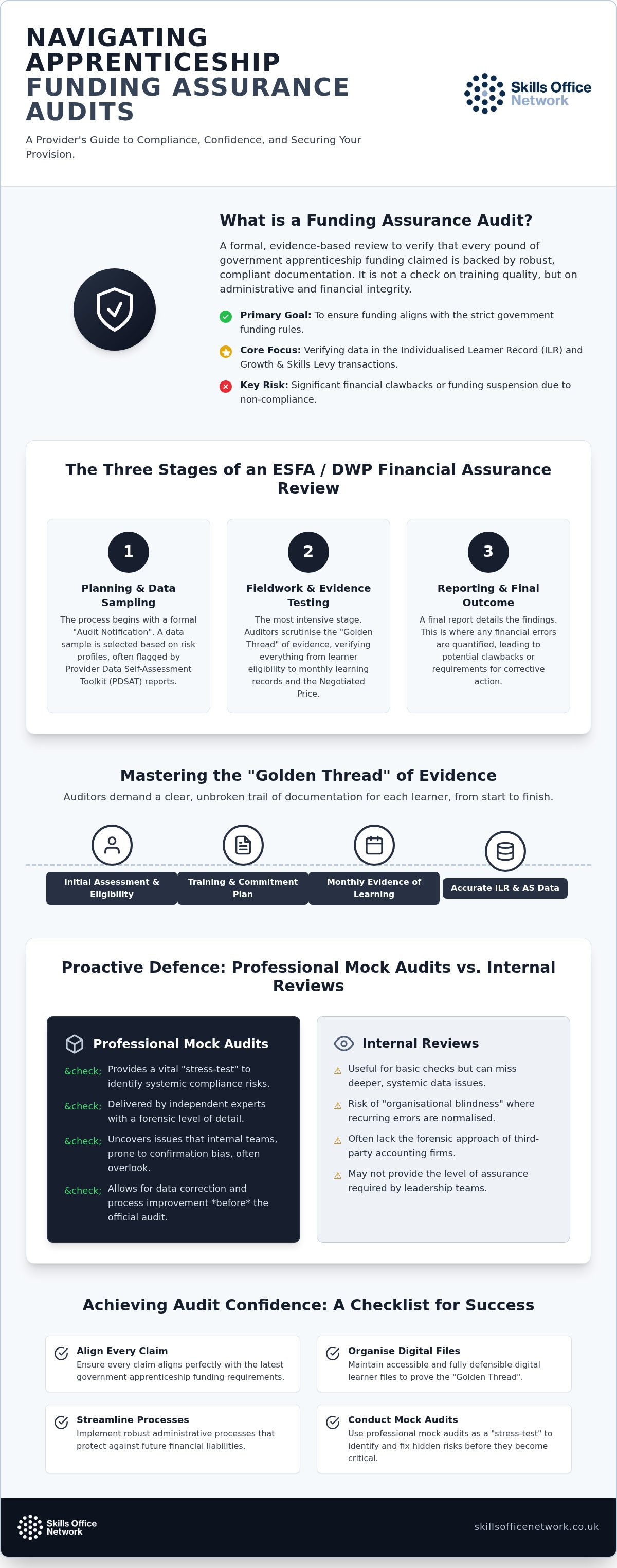
The Three Stages of the ESFA Financial Assurance Review
Understanding the rhythm of an apprenticeship funding assurance audit allows your team to move from a state of reactive panic to one of calm, organised readiness. The process is methodical. Knowing what happens at each milestone is the first step toward a successful outcome.
The review typically unfolds across three distinct phases: planning, fieldwork, and reporting. Each stage requires a specific set of internal resources and a clear communication strategy to ensure transparency and accuracy.
Planning and Data Sampling
The process begins when you receive a formal "Audit Notification" letter. This isn't a random selection. The ESFA / DWP typically selects your data sample based on specific risk profiles, often triggered by recurring errors in your Provider Data Self-Assessment Toolkit (PDSAT) reports.
In 2026, the focus on these automated flags has sharpened. Your internal team must be ready to provide the requested files immediately. This phase defines the scope of the review, so ensuring your ILR data is reconciled and error-free before this point is vital for a smooth experience.
Fieldwork: What Auditors Look For
Fieldwork is the most intensive stage of the review. Auditors will scrutinise the "Golden Thread" of evidence, starting from the initial assessment through to the actual delivery of training. They'll verify the Negotiated Price and check that every month of the programme contains tangible evidence of learning. It's essential to cross-reference your ILR data with the digital Apprenticeship Service (AS) to ensure consistency across all platforms.
Citing the importance of Ensuring Compliance with the ESFA Funding Rules is helpful here, as it highlights how discrepancies in learner eligibility or off-the-job tracking can lead to significant financial recovery. If you feel your current records might not stand up to this level of scrutiny, our Funding Assurance Review can act as a vital stress-test for your data.
Reporting is the final stage. It starts with a draft findings document that outlines any identified errors. This is your window to provide missing evidence or clarify misunderstandings before the final determination is made. The "Exit Interview" is the most critical moment in this phase. It's a formal meeting where you can discuss the auditor's initial conclusions directly. Addressing issues during this conversation can often prevent them from being recorded as formal errors, protecting your funding under the Growth & Skills Levy and ensuring the long-term health of your provision.
Professional Mock Audits vs. Internal Reviews: A Buying Guide
Internal checks are a fundamental part of daily operations, yet they often lack the critical distance required for a thorough apprenticeship funding assurance audit. It's a common challenge for even the most diligent providers. Busy data teams, deeply embedded in their own administrative cycles, can naturally develop a form of "confirmation bias." They see what they expect to see, occasionally overlooking systemic risks that an external inspector would flag immediately. Relying solely on internal reviews can leave your organisation vulnerable to significant financial recovery.
The Limitations of Internal Checks
Systemic issues often go unnoticed because staff are essentially "marking their own homework." When the same team that enters the data also audits it, the chance of spotting repetitive coding errors diminishes. During peak submission periods, resource constraints often mean these checks are rushed or postponed. Most internal teams also lack the time to master the intricate nuances of the latest government apprenticeship funding rules. Without an up-to-date understanding of the specific "Audit Working Papers" used by the authorities, your internal checks may be looking for the wrong indicators of compliance.
Choosing an External Assurance Partner
Selecting the right external partner is a strategic decision that goes beyond simple error-spotting. You need a "wise guide" who understands the broader landscape of the Growth & Skills Levy. A high-quality assurance partner will mirror the exact methodology used during an official ESFA / DWP financial assurance review. This provides a realistic "stress-test" of your systems.
When evaluating potential partners, consider these three criteria:
Methodological Alignment: Do they use PDSAT and FRM reports to drive their sampling, just as an official auditor would?
Actionable Reporting: Will they provide a detailed "Risk Mitigation Plan" that offers clear, manageable solutions for every identified issue?
Integrated Expertise: Do they understand how ILR data accuracy impacts other areas, such as Ofsted inspections and overall governance?
The cost-benefit analysis is clear. The price of a professional review is a small fraction of the potential cost of a 10% clawback. By investing in an objective eye, you aren't just buying a report; you're securing your training provision and gaining the peace of mind that your funding is safe. This proactive approach allows you to correct data before the R14 deadline, ensuring your financial health remains robust.
Critical Evidence Management: Securing Your Learner Files
Securing your learner files is the bedrock of a successful apprenticeship funding assurance audit. It's not simply about having the documents; it's about the "Golden Thread" that connects a learner's initial assessment to their final end-point assessment. This thread must remain unbroken and visible throughout the entire digital folder structure. Auditors appreciate logical navigation. If an inspector can't find a signature or a progress review within seconds, their confidence in your administrative integrity begins to wane. Poorly organised digital files often lead to "Low Value" errors. Whilst these might seem minor, they frequently trigger wider sample extensions, forcing auditors to look at a much larger percentage of your data.
The Quality of Initial Assessment
A robust audit trail starts before the learner even begins their programme. You must provide clear evidence of Recognition of Prior Learning (RPL), as this directly impacts the funding bands and the duration of the apprenticeship. If you don't adjust the price and content to account for what a learner already knows, you risk a total funding clawback for that individual. Every "Negotiated Price" needs a written justification that reflects these adjustments. Additionally, ensure the Commitment Statement is signed by all parties and fully compliant with the latest government apprenticeship funding rules. These documents form the foundation of your claim under the Growth & Skills Levy.
Monitoring Progress and Off-the-Job Hours
In 2026, the requirement for "Substantive New Learning" evidence has become a primary focus for inspectors. You can no longer rely on vague descriptions of workplace activity. Instead, you must track off-the-job (OTJ) hours with precision, ensuring they align with the planned hours recorded in the ILR. Monthly tracking is essential to avoid the "end-of-programme" panic that often leads to administrative shortcuts.
In 2026, the Evidence of Learning standard requires a chronological, verifiable record that demonstrates how each training activity directly contributes to the development of specific knowledge, skills, or behaviours outlined in the apprenticeship standard. If you're struggling to reconcile your records, our ILR & Data Support can help you align your evidence with the expected standards.
Managing breaks in learning (BiL) and withdrawals correctly is equally vital. These are high-risk areas where dates in the learner file must match the ILR exactly. A discrepancy of even a few days can result in over-claiming funding, which is an immediate red flag during an audit. By maintaining a clean, well-documented trail for every learner status change, you protect your organisation from the administrative errors that most frequently lead to financial liabilities.
Securing Your Future: How Skills Office Network Ltd. Delivers Audit Confidence
Preparing for an apprenticeship funding assurance audit can feel like a daunting task for even the most experienced providers.
At Skills Office Network Ltd., we position ourselves as your strategic partner, offering a steady hand to guide you through the complexities of government apprenticeship funding. Our approach isn't about creating alarm; it's about providing the clarity and technical expertise needed to secure your training provision. By mirroring the exact methodology used by official inspectors, we identify financial risks long before they become liabilities.
Our "Wise Guide" approach reduces the administrative burden on your leadership team, allowing you to focus on learner success whilst we handle the technical intricacies of funding requirements. This proactive stance allows you to make vital data corrections before the final R14 deadline, ensuring your organisation remains financially healthy and compliant.
Our Proven Audit Preparation Process
Our methodology is rooted in the same rigorous standards applied during an ESFA / DWP financial assurance review. We begin with a comprehensive data cleansing exercise, utilising detailed PDSAT and FRM report analysis to flag potential anomalies.
This isn't a surface-level scan. Skills Office Network Ltd. conducts deep-dive file reviews on high-risk learner samples, scrutinising the "Golden Thread" of evidence that connects initial assessment to completion. Our reporting is clear and actionable, prioritising the most significant risks so your team can focus their efforts where they matter most. This structured process removes the administrative friction often associated with audit readiness, acting as a protective shield against regulatory complexity.
Beyond Compliance: Strategic Growth
We believe that a successful audit outcome is just the beginning. The insights gained from our reviews serve as a catalyst for improving your overall Quality Assurance Framework. By strengthening your internal governance, you're better positioned to satisfy both the funding rules and the expectations of Ofsted inspectors. This holistic view ensures that your delivery of the Growth & Skills Levy is both high-quality and fully defensible.
To truly fortify your operations, you can Discover our ILR & Data Support services, which integrate seamlessly with our assurance work to provide a 360-degree compliance view. Skills Office Network Ltd. doesn't just help you pass an audit; we help you build a resilient, growth-oriented provision that can navigate the regulatory environment with total confidence.
Securing Your Provision for Long-Term Success
Navigating the complexities of an apprenticeship funding assurance audit requires more than just administrative diligence; it demands a strategic commitment to data integrity. By maintaining the "Golden Thread" of evidence and utilising robust mock audits, you protect your organisation from significant financial clawbacks. These proactive steps ensure your claims under the Growth & Skills Levy remain defensible and accurate whilst removing the burden of regulatory uncertainty from your leadership team. You've worked hard to deliver high-quality training, and your administrative records should reflect that excellence.
Our expert consultants bring deep institutional knowledge to every review, offering a proven track record of mitigating risk for training providers. We provide comprehensive support that extends to ILR management and Ofsted preparation, acting as a steady hand in a complex landscape. Book your professional Funding Assurance Review today to gain total peace of mind and streamline your compliance processes for the future. You've built a valuable training provision. We're here to help you protect it.
Frequently Asked Questions
How much notice does the ESFA / DWP give before a funding assurance audit?
Providers typically receive approximately four weeks' notice before a formal review begins. This notification arrives via an official letter outlining the scope and the initial data sample required. Whilst this provides a window for preparation, the most successful organisations maintain an audit-ready culture throughout the year to avoid a last-minute scramble for documentation or missing evidence.
What happens if the auditor finds significant errors in our ILR data?
Significant errors often lead to the extrapolation of the error rate across your entire cohort, which can result in substantial financial clawbacks. The ESFA / DWP may also increase the sample size to determine if the issues are systemic. In extreme cases, repeated or high-value failures could lead to the suspension of government apprenticeship funding until the provider demonstrates robust data improvements.
Can we correct errors identified during the audit fieldwork?
You generally cannot correct data in the ILR once the audit sample has been drawn. Fieldwork is designed to test the accuracy of the data as it stood at the point of notification. However, if you find missing evidence that existed before the audit began, you can present it to the auditor during the fieldwork phase to mitigate specific findings before the final report is issued.
How often should a training provider conduct a mock funding audit?
We recommend conducting a professional mock apprenticeship funding assurance audit at least once a year, ideally several months before the R14 hard close. This timing allows your team to identify and rectify discrepancies within the current academic year. Providers with high learner volumes or those undergoing rapid growth often benefit from bi-annual reviews to maintain tight control over their compliance frameworks.
What are PDSAT and FRM reports, and why are they important for audits?
PDSAT and FRM reports are automated tools used to identify potential anomalies in your ILR data. They flag issues like overlapping dates or missing signatures that might breach funding rules. Regularly reviewing these reports is essential, as they are the same tools the authorities use to select providers for a formal review. Addressing these flags early reduces the risk of being targeted for an audit.
Is a funding assurance audit the same as an Ofsted inspection?
No, they serve different purposes. A funding assurance review focuses on financial compliance and the eligibility of claims under the Growth & Skills Levy. In contrast, Ofsted examines the quality of education, leadership, and learner outcomes. Whilst there is some overlap in evidence, the apprenticeship funding assurance audit is primarily a forensic examination of your administrative and financial integrity rather than teaching standards.
What are the most common reasons for apprenticeship funding clawbacks?
Clawbacks frequently occur due to inadequate evidence of prior learning or failing to track off-the-job hours with sufficient detail. Other common triggers include incorrect dates for breaks in learning and missing signatures on the Commitment Statement. If the documentation doesn't provide a clear "Golden Thread" of activity, the government apprenticeship funding claimed for that learner is considered at risk and may be recovered.
How long does a typical funding assurance review take to complete?
The fieldwork phase typically takes between three and five days, depending on the size of the learner sample and the complexity of your provision. Following this, the reporting phase can take several weeks as the auditors draft their findings and allow for your formal response. The entire process, from notification to the final determination, usually concludes within two to three months.


