
Apprenticeship Funding Claim Validation: Provider Guide
Updated: Aug 13
A single misaligned date in your Individualised Learner Record (ILR) can be the difference between a successful payment and a stressful funding clawback. If you've spent hours deciphering cryptic PDSAT and FRM error messages, you're certainly not alone. Many providers find the process of apprenticeship funding claim validation to be a constant source of administrative friction. It's frustrating when manual data entry errors lead to payment delays, especially whilst you're trying to maintain a consistent monthly cash flow.
We understand that the transition to the Growth & Skills Levy and the updated Version 3 funding rules for 2026 have added new layers of complexity to your operations. This guide will help you master the intricacies of ESFA / DWP claim validation so you can secure your government apprenticeship funding with absolute confidence. You'll learn how to achieve 100% clean ILR submissions by ensuring a perfect three-way alignment between your data, the Apprenticeship Service, and your physical learner files. By following these proven standards, you'll eliminate audit risks and ensure your records are always ready for inspection.
Table of Contents
Understanding the Core Pillars of Apprenticeship Funding Validation
Validation is the bedrock of a sustainable apprenticeship provision. It represents the rigorous verification of two distinct but inseparable elements: data accuracy and evidence sufficiency. Within the framework of the Growth & Skills Levy, your Individualised Learner Record (ILR) acts as the primary vehicle for securing government apprenticeship funding. However, many providers mistake technical cleanliness in their ILR software for absolute audit compliance. A file that passes a software validation check simply means the data is in the correct format. It doesn't guarantee that the underlying claim is eligible or evidence-backed. Precision is non-negotiable.
Failing to maintain a robust apprenticeship funding claim validation process carries significant financial risks. Over-claiming, even if accidental, often results in severe funding clawbacks during an ESFA / DWP audit. Conversely, under-claiming through cautious data entry or missed evidence can starve your organisation of the revenue it has rightfully earned. Striking the right balance requires a deep understanding of the funding rules and a commitment to data integrity. Data alone isn't enough.
The Three-Way Match: ILR, DAS, and Evidence
Successful validation relies on a perfect alignment between three sources of truth. First, the Digital Apprenticeship Service (DAS) must accurately reflect the apprentice's status and employer details. Historically managed through the National Apprenticeship Service, this digital interface must mirror your internal ILR records exactly. Second, the ILR data must be precise. Finally, the learner file must contain the hard evidence supporting every data field, such as signed initial assessments and evidence of off-the-job training. Mismatches between these three pillars are the most common triggers for payment holds. Compliance is a trifecta.
Why Validation is a Continuous Monthly Cycle
Effective providers move away from deadline-day panic. Instead, they adopt a rolling review process that spans the entire academic year, from R01 through to the final R14 submission window. This methodical approach ensures that errors are identified and corrected in real-time, rather than being left to accumulate. Regular validation protects your cash flow stability by ensuring that monthly payments are predictable and accurate. It transforms a high-stakes administrative burden into a manageable, strategic routine that supports long-term growth. Consistency builds confidence.
Technical Validation Tools: Leveraging PDSAT and FRM Reports
Technical tools are the first line of defence in your apprenticeship funding claim validation strategy. Whilst many providers rely solely on their ILR management software, true assurance comes from interrogating the specific reports generated by the government's own systems.
Understanding the technical validation rules is essential, but interpreting the output requires a strategic eye. You must distinguish between "Errors," which prevent payment entirely, and "Warnings," which may still result in payment but flag potential compliance risks for future audits. A reactive approach often leads to missed deadlines, so adopting a proactive stance is vital for long-term stability.
Mastering PDSAT for Funding Assurance
The Provider Data Self-Assessment Toolkit (PDSAT) is the primary tool for identifying data anomalies before the ESFA / DWP does. In 2026, compliance officers should focus on reports that highlight high-risk learner cohorts, such as those with unusual planned durations or those nearing their planned end dates without completion evidence. Using sampling techniques to deep-dive into these specific records allows you to verify that the data matches the physical evidence. If you find the volume of reports overwhelming, seeking expert ILR & data support can help streamline your review process and reduce the administrative burden on your team.
Navigating FRM Reports to Minimise Risk
Funding Monitoring (FRM) reports identify potential breaches of funding rules across your entire provision. While there are dozens of reports, ranging from FRM01 to FRM37, some carry much higher financial risks than others. For example, FRM06 (Duplicate records) and FRM27 (Learners with no activity for 60 days) require immediate investigation. These reports act as a "smoke alarm" for your data, indicating where the government's systems see a mismatch between your claims and the expected behaviour of a valid apprenticeship programme.
To maintain a clean record, you should:
Integrate FRM reviews into your monthly governance meetings to ensure senior oversight and accountability.
Document your "clearing" process for every flagged record to provide a clear audit trail for inspectors.
Cross-reference FRM flags with your internal learner file audits to ensure qualitative evidence supports the digital record.
Proactive use of these tools ensures that your government apprenticeship funding remains secure. By identifying and correcting issues within the R01 to R14 windows, you strengthen your apprenticeship funding claim validation process and safeguard your organisation's financial health. This continuous cycle of review transforms data management from a technical chore into a strategic asset.
Data Accuracy vs. Evidence Validity: The Hidden Audit Trap
A common misconception in the sector is that a "clean" ILR submission, free from technical errors, equates to a safe funding claim. In reality, technical validation only confirms that your data follows the correct syntax and structure. The true challenge lies in qualitative validation: ensuring that the physical evidence in your learner files justifies every penny of government apprenticeship funding you receive. An ILR entry might be technically valid but still constitute an invalid funding claim if the underlying evidence is missing, incomplete, or contradictory. This gap between data and evidence is where most audit risks reside.
Evidence failures typically cluster around three areas: Initial Assessments, Off-the-Job (OTJ) logs, and Progress Reviews. For example, if an ILR indicates a learner is active, but their OTJ logs show no entries for 60 days, you are essentially carrying a "ghost learner." Validation processes must identify these discrepancies before they trigger a Funding Monitoring (FRM) report. Consistent apprenticeship funding claim validation requires a meticulous comparison between what the software says and what the digital trail proves. Precision is your best defence.
Validating Initial Assessment and Prior Learning
Under the 2026 funding rules, your price breakdown must clearly reflect a reduction for prior learning. If a learner has relevant experience, the "Negotiated Price" field in your ILR should be lower than the standard funding band maximum. This must be explicitly linked to the Training Plan.
You must also ensure the 20% OTJ minimum is mathematically sound based on the apprentice's working hours and the duration of the programme. If the training plan doesn't align with the ILR price, the entire claim becomes vulnerable during an ESFA / DWP review. Clarity here is essential for the Growth & Skills Levy compliance.
The Audit Trail: From Signature to Submission
Precision in your audit trail is vital for maintaining cash flow and demonstrating integrity. Digital signatures for 2026 must be secure and verifiable, with time-stamps that align logically with the start of the programme. You must ensure that the start and end dates on the ILR match the "Employer Agreement" exactly. An audit failure often stems from a single date discrepancy between documents. By synchronising these dates during your internal apprenticeship funding claim validation checks, you act as a protective shield for your organisation's financial health. Thoroughness today prevents complications tomorrow.
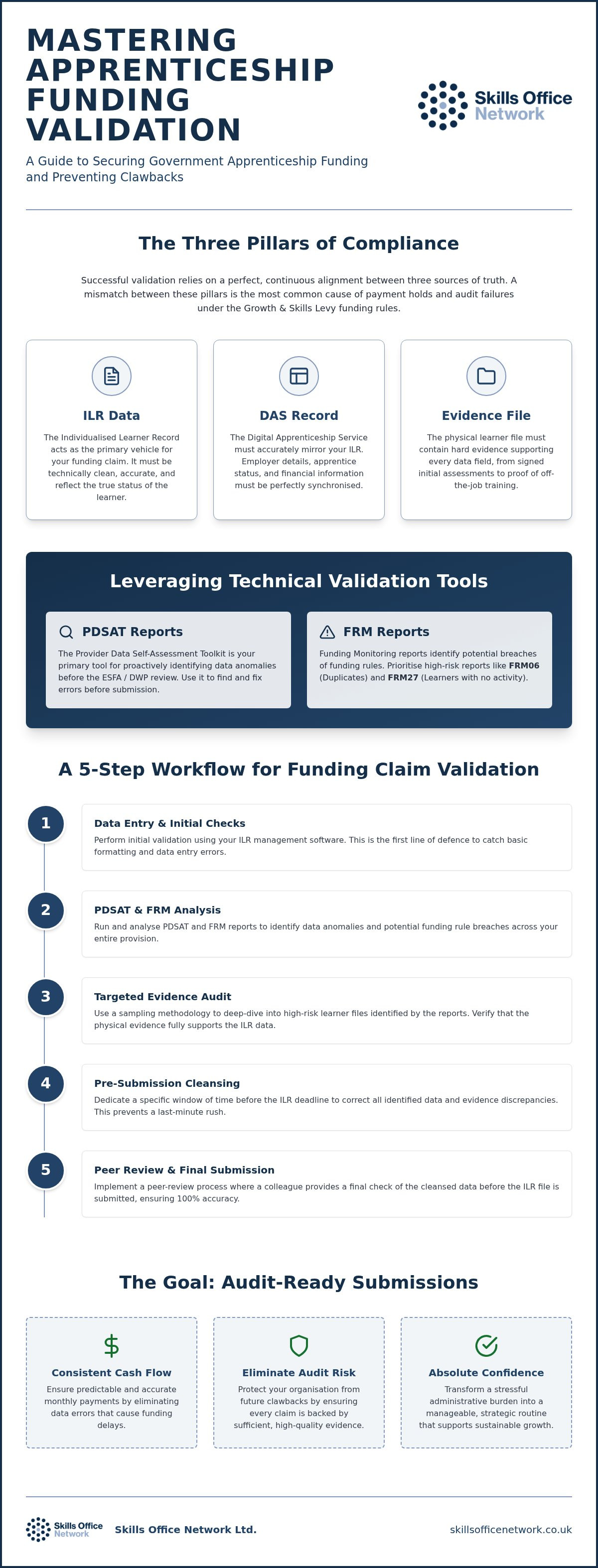
A 5-Step Internal Workflow for Funding Claim Validation
Establishing a structured internal routine is the most effective way to eliminate administrative friction and secure your government apprenticeship funding. Instead of treating data management as a last-minute task, successful providers build a proactive system that catches errors before they reach the submission portal. This 5-step workflow moves your team from a reactive "fix-it" mindset to a position of strategic control. Consistency is the key to maintaining a healthy relationship with the regulatory environment.
Step 1 & 2: Data Entry and Initial Cleansing
The foundation of a clean ILR submission is standardised data entry. By creating clear internal protocols, you reduce the risk of manual "typo" errors that often lead to payment delays. Once the data is entered, you should run internal "mock" validation reports through your Management Information System (MIS). This allows you to identify and address "Header" and "Learner" level errors immediately. It's far easier to correct a postcode or a Unique Learner Number (ULN) at the point of entry than it is to track down the information hours before the submission window closes. Accuracy at the start prevents headaches at the end.
Step 3 & 4: Evidence Matching and Reconciliation
Technical correctness doesn't guarantee compliance. To ensure your apprenticeship funding claim validation is robust, conduct a "Deep Dive" on at least 5% of new starts each month. This involves manually checking that every data field in the ILR is backed by a signed document in the learner file. Simultaneously, you must reconcile your records with the Apprenticeship Service to identify "Data Locks" or "DLOCK" errors. Under the Growth & Skills Levy, resolving co-investment discrepancies with employers is also vital to prevent funding gaps. If your team is struggling to keep up with these technical demands, our expert ILR & data support can provide the additional capacity you need to stay compliant.
The final step in the process is the reconciliation of DAS and ILR data, which should occur at least five days before the submission deadline. This buffer allows for any last-minute adjustments without the pressure of a ticking clock. Finally, a formal sign-off by the Head of Data or Compliance ensures that the organisation takes collective responsibility for the submission. This structured approach transforms the validation cycle into a predictable, manageable process that safeguards your cash flow and provides ultimate peace of mind. By following these steps, you act as a protective shield against the complexities of the ESFA / DWP requirements.
Securing Your Claims with Professional Funding Assurance
Even with the most diligent internal workflows, a fresh perspective is often the final piece of the compliance puzzle. Independent funding assurance reviews act as a vital safety net, ensuring that your apprenticeship funding claim validation processes are not just functional, but bulletproof. This external scrutiny identifies the subtle errors that internal teams might overlook due to familiarity or systemic bias. By engaging a partner who understands the nuances of the Growth & Skills Levy, you transform your data management into a strategic asset that withstands the most rigorous inspections.
Why Independent Reviews are Essential
Removing internal bias is perhaps the most significant benefit of an external review. Compliance officers are often too close to the daily data entry to see wider patterns of risk. External consultants bring a wealth of institutional knowledge, having witnessed best practice across the entire sector. This breadth of experience allows them to identify rule breaches before they escalate into significant financial penalties. For senior leadership, this provides an invaluable sense of security during inspection periods, allowing you to face an ESFA / DWP visit with absolute confidence. Peace of mind is a powerful motivator.
How Skills Office Network Ltd. Protects Your Funding
We specialise in providing tailored ILR and data management support, particularly for niche providers who may not have extensive internal compliance departments. Our team conducts deep-dive analysis of PDSAT and FRM reports to clean your data, ensuring that every claim is backed by a valid, audit-ready evidence trail. This methodical approach doesn't just protect your current revenue; it often identifies lost opportunities where funding has been under-claimed due to cautious data practices. Let us organise your compliance framework today to ensure your organisation remains a leader in quality delivery.
Building a culture of compliance is about more than just avoiding clawbacks. It's about demonstrating integrity to your employers, your learners, and the regulators. When your apprenticeship funding claim validation is handled with professional precision, it sends a clear message to Ofsted and the ESFA / DWP that your provision is managed with excellence. Outsourcing the administrative burden allows your team to redirect their focus toward what truly matters: delivering high-quality vocational training that changes lives. Let our expertise be your protective shield in this complex regulatory environment.
Future-Proofing Your Funding Strategy
Mastering apprenticeship funding claim validation requires more than just clean data; it demands a perfect alignment between your ILR records and the physical evidence in your learner files. By adopting a proactive monthly workflow and leveraging tools like PDSAT and FRM reports, you can transform compliance from a source of stress into a competitive advantage. This approach ensures your organisation remains resilient against the complexities of the Growth & Skills Levy and evolving funding rules.
As specialists in ILR data management with deep experience in Ofsted and ESFA / DWP compliance, we provide bespoke consultancy for UK training providers. We act as your strategic partner, removing the administrative burden so you can focus on delivering exceptional vocational training. Our expertise serves as a protective shield, allowing you to face audits with absolute certainty. Secure your funding with a professional Funding Assurance Review today. With the right framework in place, you'll navigate the 2026 regulatory landscape with confidence and clarity.
Frequently Asked Questions
What are the most common ESFA / DWP validation errors in 2026?
Common errors in 2026 often involve discrepancies in the Negotiated Price field after accounting for prior learning. As discussed, these often stem from mismatches between the training plan and the ILR. Other frequent issues include incorrect completion status for learners who have reached their gateway. Ensuring consistent apprenticeship funding claim validation helps catch these specific technical flags before they lead to payment suspensions in the final R14 window.
How often should we run PDSAT reports for funding validation?
You should aim to run PDSAT reports at least once every month, ideally aligned with your internal data cleansing window. This frequency allows you to identify anomalies before the monthly ILR submission deadline. By prioritising these reports, you can address potential rule breaches in real-time rather than waiting for the end of the academic year. This consistent routine ensures your data remains clean and your government apprenticeship funding remains secure.
Can a "Data Lock" error on the Apprenticeship Service stop our funding?
A Data Lock (DLOCK) will certainly stop your funding for the affected learner until the mismatch is resolved. This usually happens when the ILR data contradicts the information the employer has approved on the Apprenticeship Service. Common causes include mismatched UKPRNs or start dates. Resolving these requires immediate coordination with the employer to ensure both records are identical, which is a vital part of the monthly reconciliation process.
What happens if we identify an over-claim during our internal validation?
If you identify an over-claim, you should adjust the ILR data immediately in the next available submission window. This proactive correction demonstrates a commitment to the funding rules and reduces the risk of penalties during an ESFA / DWP audit. It's far better to self-identify and rectify a payment surplus than to have it discovered as a systematic error during a formal funding assurance review, which could trigger a wider investigation.
How do we validate "Off-the-Job" training hours for part-time apprentices?
For part-time apprentices, you must calculate the minimum 20% off-the-job training requirement based on their actual contracted hours. If an apprentice works fewer than 30 hours per week, the duration of the programme must be extended proportionally to meet the total hour requirement. Validating these claims involves checking that both the ILR duration and the training plan reflect this calculation accurately. Precision here prevents flags in the FRM report suite.
Is digital evidence as valid as paper-based evidence for ESFA / DWP audits?
Digital evidence is fully accepted for ESFA / DWP audits, provided it meets the specific 2026 standards for security and authenticity. This includes time-stamped digital signatures and secure storage that ensures documents remain unalterable. Whilst paper records are still permissible, digital systems often streamline the validation process by making evidence more accessible for internal spot-checks. Modern compliance frameworks favour these digital audit trails because they significantly reduce the physical administrative burden.
What is the difference between a "Warning" and an "Error" in the ILR submission?
An "Error" is a critical failure that stops your data from being processed, whereas a "Warning" allows the submission but flags a potential risk. You won't receive funding for any records containing errors. Warnings, however, are often used by the ESFA / DWP to identify providers for future audits. Addressing warnings is just as important as fixing errors if you want to maintain a clean compliance profile and avoid future funding clawbacks.
How can we reduce the time spent on manual claim validation?
To reduce manual effort, you should implement an automated pre-validation step within your Management Information System (MIS) before running PDSAT reports. Combining this with a risk-based sampling strategy, focusing on a specific percentage of high-risk records, allows you to maintain high standards without checking every single file. This balanced approach ensures your apprenticeship funding claim validation remains thorough whilst freeing up your data team to focus on strategic oversight and resolving complex flags.


